Care Guide
How to keep each material at its best — from rattan to linen, ceramics to stone.
Rattan & wicker
Rattan is a climbing palm, hand-woven by our workshop in Cirebon, Indonesia. It stays beautiful for decades if you keep it dry, dusted, and out of direct sun.
Everyday care
- Dust weekly with a soft, dry brush (a natural-bristle paintbrush works) or the soft attachment of a vacuum
- For deeper cleaning: a slightly damp microfibre cloth with a drop of neutral soap, wiped in the direction of the weave, then dried immediately
- Never soak rattan — water trapped inside the cane causes mould
What to avoid
- Direct sunlight for long periods — it bleaches the natural colour and dries the fibres
- Radiators and heat sources within one metre — cracks the cane
- Wet cloths, harsh detergents, bleach, ammonia
If it dries out
Every few years, in very dry indoor climates, rattan can be refreshed by misting lightly with water and letting it air-dry overnight — the fibres relax and tighten again.
Linen & natural textiles
Our throws, cushions and curtains are woven in small family mills in northern Portugal. Linen softens with every wash — that's the point. It also creases; that's also the point.
Washing
- Machine wash cold (30°C max), gentle cycle, mild detergent without optical brighteners
- Wash similar colours together — natural dyes can transfer on first wash
- No bleach. No fabric softener (it coats the fibre and stops it softening naturally)
Drying & ironing
- Air dry flat or on a line out of direct sun. Tumble drying low is acceptable but shortens the life
- Iron slightly damp on the reverse side, medium heat, steam on
- Creases are not a flaw. If you iron only once a season, it's enough
Spot cleaning
Blot spills immediately with a clean, dry cloth — never rub. For stains, cold water and mild soap, worked gently from the outside in.
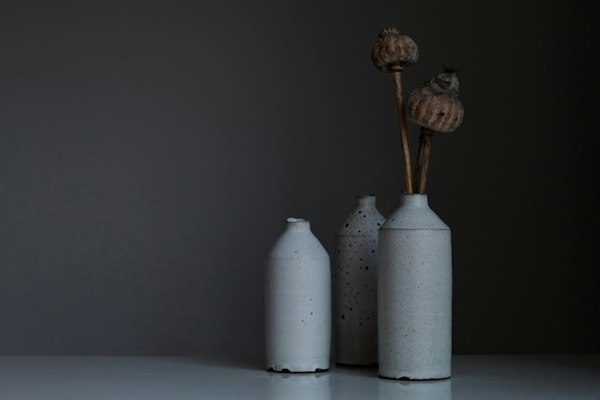
Ceramic & stoneware
Our vases, bowls and tableware are thrown and fired in Tuscan studios at high temperature. Most pieces are unglazed or partly glazed — part of the wabi-sabi character.
Cleaning
- Hand wash with warm water and mild dish soap, dry immediately with a soft cloth
- Avoid the dishwasher unless the piece is marked "dishwasher safe" on the care tag
- For mineral build-up in vases: a mix of warm water and white vinegar, soaked briefly, then rinsed
Handling
- Always two hands. Ceramic is harder than you think, but impact-fragile
- No thermal shock — don't take a piece from the fridge straight to a hot oven, or rinse a hot piece in cold water
- Unglazed bases can mark wood over time. Use a felt pad underneath
Hairline cracks
A fine hairline in a vase or bowl is usually cosmetic and can be lived with. If it leaks, email us — we'll replace or repair under the 2-year conformity guarantee.
Travertine & stone
Our travertine, limestone and slate pieces come from small quarries in Tuscany and the Basque country. Stone is porous — it changes a little with use, and benefits from light sealing.
Daily care
- Wipe with a damp soft cloth and warm water. No harsh detergents
- Blot spills immediately, especially wine, oil, coffee, citrus — all can stain porous stone
- Use coasters and placemats under anything wet or acidic
Sealing
- Tabletops and high-use surfaces: reseal once a year with a natural stone sealer (matte, water-based)
- Decorative pieces: sealing is optional — the patina that develops is part of the character
What not to use
No vinegar, no lemon, no bleach, no ammonia — acids etch the surface permanently. If in doubt, just water.
Solid wood (walnut, oak)
Our wood pieces — bases, trays, small furniture — are milled and hand-finished in family workshops in Belgium and Italy, oiled rather than varnished so the grain stays alive to the touch.
Everyday
- Dust with a dry, lint-free cloth. Once a month, wipe with a barely damp cloth and dry immediately
- Use coasters for anything warm or wet. Keep hot pans off the surface
- Keep at least 50 cm from radiators and out of direct afternoon sun
Oiling (once or twice a year)
- Clean the surface, let it dry completely
- Apply a thin coat of natural furniture oil (tung, linseed or our recommended Osmo Topoil 3028) with a cotton cloth, in the direction of the grain
- Leave 20 minutes, then buff off the excess. Let it cure overnight before use
Scratches & marks
Light scratches can be sanded gently with 400-grit sandpaper along the grain, then re-oiled. Water rings usually lift with a light oil treatment. Deep damage — email us, we have touch-up kits for each wood species.
Light & sunlight
Most natural materials — rattan, linen, wood, dyed textiles — fade under direct, prolonged sunlight. If a piece sits in a south-facing window, rotate it 180° every few months so it fades evenly, or shade the window with sheer curtains during peak hours.
Humidity & temperature
The sweet spot for most natural materials is 40–60% relative humidity, 18–22°C. Below 30% humidity (typical in heated European homes in winter), wood and rattan can crack. A single humidifier in the room solves it.
Unboxing & first days
- Let wood and textile pieces acclimatise for 24–48 hours before placing or using them — they need to settle into your room's humidity
- Keep the original packaging for your first 30 days in case of return
- Natural variation — subtle differences in grain, weave, or glaze — is not a defect. It's the mark of handwork
When to reach us
If something isn't right — a crack that shouldn't be there, a finish that doesn't behave as expected, damage in transit — email support@krevalo.co within 48 hours of noticing it. Every Krevalo piece carries a 2-year conformity guarantee and, for most categories, a longer voluntary craft warranty. We'd rather hear from you early than find out at year three.
We also keep touch-up kits, replacement cords, and small repair materials in stock for most product lines — often free of charge, always within reason.